

Water Fed Pole Window Cleaning South Florida Guide
Updated: Sep 15
In South Florida, window cleaning decisions often come down to more than building height. Coastal salt, humidity, hard water, access points, and the need to keep properties operating all affect which method makes sense. For many low-rise and mid-rise properties, a water-fed pole can provide ground-based reach with a controlled process. For taller or more complex buildings, drone cleaning may offer another practical option.
Call Skybots at (305) 395-1496 to schedule a free site inspection and discuss the right approach for your property.
Water fed pole window cleaning South Florida is well suited to many windows up to roughly five stories. While drone cleaning can help address exterior areas on buildings from about three to 20 stories. The right choice depends on height, access, surface conditions, site safety, and the finish required.
Understanding how each system handles water, reach, and operator access makes it easier to evaluate the options before planning service.
Water Fed Pole Window Cleaning South Florida: How Water-Fed Pole Window Cleaning Works
Water-fed pole cleaning combines purified water, lightweight equipment, and trained ground-based operators. The process is especially useful for many windows within the reach of a telescoping pole, while the right access method still depends on the building and surface.
Purify the water through three filtration stages
The system first passes ordinary water through a carbon filter, which helps remove chlorine and sediment. It then moves through a reverse osmosis membrane to reduce dissolved minerals. Finally, deionization resin removes remaining charged particles. The result is highly purified water with a total dissolved solids level of 10 or less, a practical target for spot-free window cleaning. In South Florida, where hard water and coastal conditions can leave mineral and salt deposits, this filtration step is central to the finish.
Extend the carbon-fiber pole from the ground
A telescoping carbon-fiber pole gives the operator reach without carrying a ladder from window to window. Water-fed poles are designed to clean elevated windows from the ground, reducing the need for ladders or scaffolding for many tasks, as described in this water-fed pole patent record. Depending on the property, equipment, and conditions, trained crews can typically reach windows about 50 to 70 feet high, or approximately five stories.
Agitate the glass with a brush and water jets
A brush head loosens dust, salt, and other surface residue while small jets deliver the purified water across the glass. Unlike a conventional soap-based wash, the process does not rely on detergent to leave a film behind. Pure water acts like a magnet for dirt and lifts contaminants from the surface, allowing the glass to dry without the spotting caused by minerals in untreated water.
Work safely with trained ground-based crews
Ground-based access does not eliminate the need for planning or training. OSHA and the International Window Cleaning Association developed water-fed pole safety training covering proper use of the equipment. OSHA's IWCA Alliance report documents that training approach. For broader property maintenance planning, review this commercial exterior cleaning guide and match the method to height, access, glass condition, and the building's surrounding environment.
Water-Fed Pole vs. Squeegee: What's the Difference?
Both methods can produce clean, professional-looking glass. The right choice depends on the building's height, window design, access conditions, and the finish required. A squeegee gives an operator direct control over the glass, while a water-fed pole lets the operator work from the ground on many elevated windows.
Method | Height Reach | Water Type | Residue | Safety | Best For |
Squeegee | Ground-floor and accessible windows | Water with soap or cleaning chemicals | Requires manual drying to prevent marks | Direct handling; access requirements vary by site | Storefronts, ground-floor glass, and detailed spot work |
Water-fed pole | Up to about 50 feet, or roughly 5 stories, from the ground | Purified water monitored for low TDS | No soap residue; dries streak-free when properly purified | Ground-based operation for many elevated windows; trained use is essential | Upper windows on low- to mid-rise buildings and larger glass areas |
How the finish differs
Squeegee cleaning uses a washer, solution, and rubber blade. It remains effective for ground-floor windows and storefronts, especially where an operator needs close visual control or must address a small area. Larger properties can require more manual labor because each section is washed and dried by hand.
A water-fed pole system uses purified water rather than soap. The low-mineral water lifts dirt and dries without the residue that ordinary water can leave behind. Operators can clean many windows from the ground, reducing the need for elevated access equipment. Water-fed pole systems still require proper training and site assessment. OSHA and the International Window Cleaning Association provide safety training guidance for this equipment.
For South Florida property owners comparing service options, review this window cleaning cost breakdown alongside the building's height and access needs. In many cases, a blended plan uses squeegees for accessible glass and water-fed poles for elevated sections.
When Drone Window Cleaning Is the Better Choice
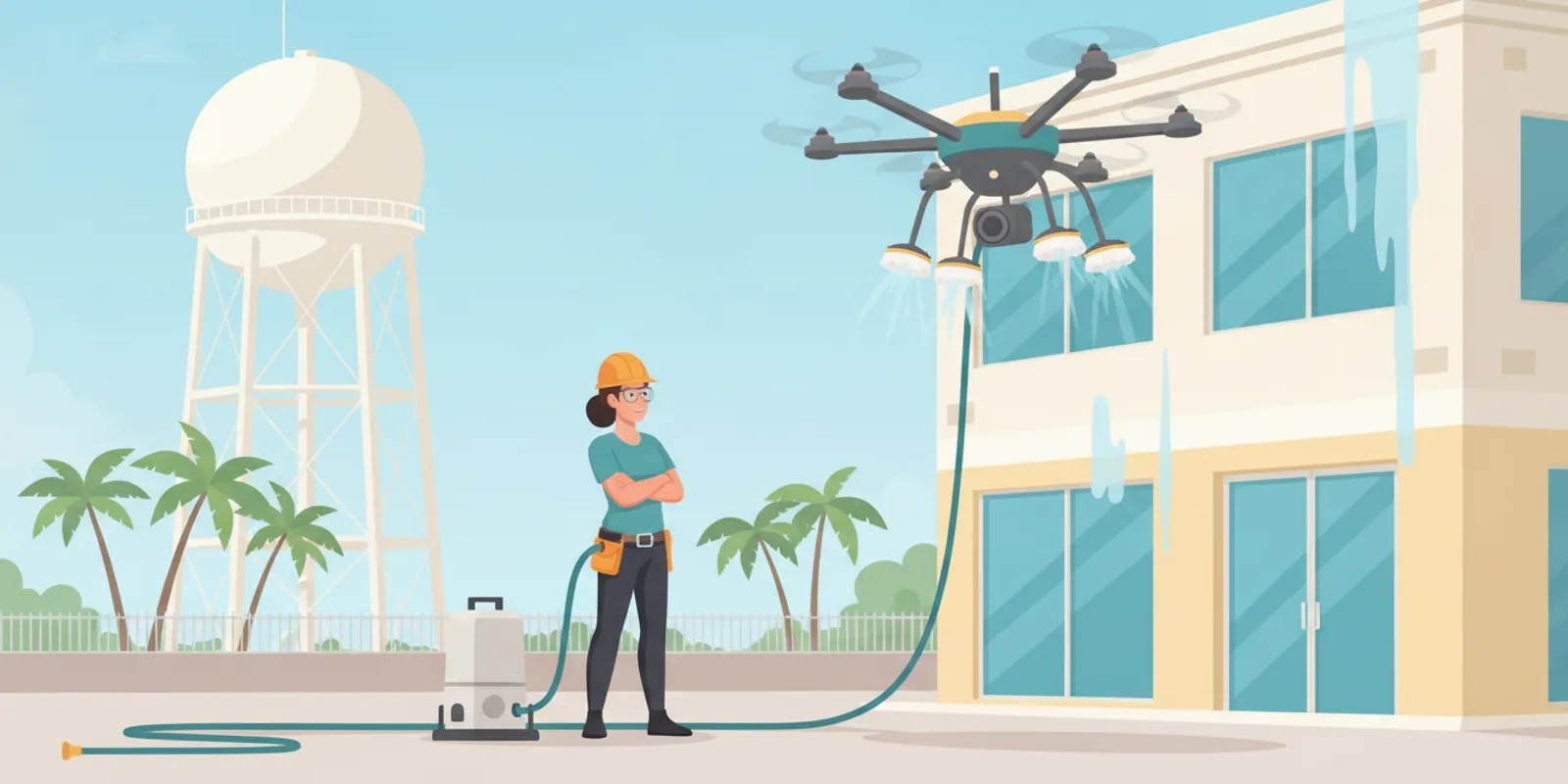
Water-fed poles are practical for many low-rise properties, but they have a reach limit. When a building rises beyond that range or has difficult exterior access, drone window cleaning can provide a more controlled way to maintain upper windows and surrounding surfaces. Skybots generally sees the strongest fit for buildings between three and 20 stories, where access planning matters as much as the cleaning method.
Call Skybots at (305) 395-1496 to discuss the safest method for your property.
When height and access change the equation
A water-fed pole can clean high windows from the ground and is often a strong choice for properties up to roughly five stories. It is also useful when the building layout gives the operator clear access from below. For taller structures, recessed windows, courtyards, overhangs, or areas where a pole cannot be positioned effectively, a drone can reach surfaces that are harder to approach manually.
Skybots uses a soft-wash process with adjustable pressure, allowing the operator to match the cleaning approach to the surface and level of buildup. FAA Part 107 certified pilots manage the flight and cleaning operation, while the ground team maintains site coordination. The result is a touch-free process that can reduce the need for suspended access work and the related scaffolding suspension risks. Lifts or scaffolding may still be appropriate for some properties, but they are not the only access option.
When faster setup supports building operations
Traditional access systems require planning, delivery, assembly, and staging around the property. For qualifying projects, drone setup can be five times faster than scaffolding or lifts, helping reduce disruption for residents, tenants, visitors, and facility teams. It can also reduce the time that equipment occupies driveways, sidewalks, loading zones, or other active areas.
That does not make one method universally better. Skybots offers both water-fed pole and drone cleaning, selecting the approach based on building height, window design, surface condition, access, and site requirements. Review the drone cleaning services guide for more detail, then request a property-specific recommendation rather than choosing by equipment alone.
How to Choose: Building Height, Access, and Budget
The right cleaning method depends on more than the number of floors. Property managers should weigh window access, surrounding conditions, scheduling requirements, and the type of finish needed. Skybots evaluates each property before recommending a practical approach, so the plan fits the building rather than forcing every project into one system.
Need help comparing options? Schedule a site evaluation with Skybots before you commit to equipment or access arrangements.
Tier 1: Ground-floor and single-story properties
For storefronts, ground-floor windows, and single-story buildings, a squeegee or ground-level water-fed pole may be the most straightforward choice. These methods provide direct access and work well when the cleaning area is easy to reach from a stable surface.
Tier 2: Two- to five-story buildings
Water fed pole window cleaning South Florida property managers often select for low-rise buildings can reach windows from the ground. Typically up to about 50 to 70 feet, or roughly five stories. This approach can reduce the need for ladders and elevated access equipment while maintaining an efficient workflow. It is often the practical sweet spot for apartment buildings, offices, and other low-rise properties.
Tier 3: Three- to 20-story buildings
Drone cleaning may be the better fit when the exterior rises beyond comfortable ground-level reach or when access is difficult to stage. Skybots uses this method for suitable 3- to 20-story properties, where faster setup and reduced dependence on scaffolding can simplify planning. The building layout, weather, surface, and surrounding area still determine whether it is appropriate.
Tier 4: Taller or unusually complex properties
For buildings above 20 stories, or properties with complex setbacks and access limitations, traditional methods such as scaffolding or lifts may be needed for some areas. These methods remain useful when the project requires close, sustained access.
Budget should be considered alongside safety, disruption, scheduling, and the expected finish, not as a standalone price comparison. Skybots can recommend water-fed pole, drone, or other access methods after reviewing the property. Every service also includes a three-day post-service guarantee. Explore our South Florida window cleaning solutions or learn more about Skybots.
South Florida Considerations for Window Cleaning
South Florida properties face a different maintenance environment than buildings in drier inland regions. Ocean air, mineral-heavy water, and persistent humidity can affect both the appearance of glass and the timing of a cleaning program. For property managers in Miami-Dade, Broward, and Palm Beach, the right method should account for local exposure rather than follow a one-size-fits-all schedule.
Coastal salt requires consistent maintenance
Salt carried by coastal air can settle on windows and exterior surfaces, leaving visible residue and contributing to spotting over time. Properties closer to the coast may need more frequent service to prevent buildup from becoming harder to remove. For many coastal commercial properties, cleaning every three to four months is a practical starting point, with adjustments based on exposure, building orientation, and visible accumulation.
Hard water makes filtration essential
South Florida water can contain enough dissolved minerals to leave spots when it dries on glass. That makes filtration a critical part of water fed pole window cleaning South Florida property managers can rely on for a clean finish. An effective reverse osmosis and deionization system should reduce total dissolved solids to 10 or below before the water reaches the glass. Without adequate RO/DI treatment, even careful work may leave mineral marks behind.
Humidity affects shaded glass and exteriors
High humidity supports mold, mildew, and algae growth on building exteriors. North-facing and shaded windows can be especially vulnerable because they receive less direct sunlight and may stay damp longer. Skybots evaluates these conditions when recommending a maintenance plan, using water-fed pole systems where access and height make sense and other specialized methods when the property requires them. See the drone cleaning services guide for more on how building conditions influence method selection.
Frequently Asked Questions
How does water-fed pole cleaning compare with drone cleaning?
Water-fed poles are a practical choice when windows can be reached from the ground, especially on lower buildings and many two- to five-story properties. Drone cleaning is better suited to taller or more complex elevations where poles cannot reach efficiently or where access is difficult. The right method depends on building height, facade conditions, access, and the level of precision the project requires. Skybots can assess the property and recommend a method, or a combination of methods, for the specific site.
What is the maximum height for water-fed pole window cleaning?
Water-fed pole systems commonly reach about 50 to 70 feet, or approximately five stories, from the ground. Actual reach depends on the equipment, site layout, wind, obstacles, and the technician's ability to work safely. When windows extend beyond practical pole reach, a drone, lift, or another access method may be more appropriate. A site assessment is the best way to confirm the workable height for a particular building.
Why is pure water used for this type of window cleaning?
Pure water has minerals and dissolved solids removed through filtration, allowing it to dry with less residue on the glass. This supports a spot-free finish when the system is used correctly. South Florida's hard water makes filtration and water quality especially important, because higher dissolved-solids levels can increase spotting after drying. The system and operating method should be matched to the property's conditions.
Is water-fed pole cleaning safer than traditional methods?
It can reduce the need for ladders or scaffolding on suitable tasks because technicians work from the ground. Water-fed pole use still requires training, careful setup, and attention to site conditions. OSHA and the International Window Cleaning Association have recognized the need for specialized safety training for water-fed pole use: OSHA and IWCA safety guidance. For taller or harder-to-access areas, another method may provide the more controlled solution.
Can water-fed poles remove salt buildup from South Florida windows?
They can help remove surface salt and other deposits when the glass and surrounding conditions are suitable for water-fed cleaning. Coastal properties may need more frequent maintenance because salt carried in ocean air can accumulate on exterior surfaces. The cleaning plan should also account for hard water, humidity, facade materials, and the condition of the windows. For areas beyond pole reach, drone or other access methods can be evaluated as part of the same maintenance plan.
Schedule a Site Inspection for the Right Cleaning Method
Every property has different access, height, and maintenance requirements. A site inspection helps identify whether water-fed pole cleaning, drone cleaning, or another professional method is the right fit for your building. To discuss your property and plan the next step, call Skybots at (305) 395-1496 to schedule your free site inspection today.


Comments