

What Should Property Teams Know Before Scheduling a Water Tower Inspection? Window Cleaning Drones and Scope
Before scheduling a water tower inspection, define what asset and conditions need review, confirm who is qualified to assess them, and coordinate site access, safety controls, and records. Window cleaning drones are a separate exterior-cleaning tool, not a substitute for a qualified inspection or structural assessment. Treat inspection and cleaning as distinct work scopes, then coordinate them when both are needed.
What should a water tower inspection cover?
“Water tower inspection” can refer to different kinds of review. A facility team might need an operational check, a sanitation review, a structural assessment, a coating evaluation, or a documented condition survey. Those activities may involve different qualifications, procedures, and access plans. Start by naming the decision the inspection must support, not by booking a generic visit.
For example, a team preparing a maintenance budget may want a condition record and prioritized recommendations. An operator responding to a concern may need a targeted assessment by an appropriately qualified professional. If the tower stores drinking water, clarify applicable requirements with the responsible utility and local or state authority. The U.S. Environmental Protection Agency provides federal drinking-water information, but your authority having jurisdiction can confirm which rules apply to your asset.
Ask the inspector to state the limits of the work in writing. A visual review from the ground is not the same as close access to the structure. A coating observation is not automatically a full structural evaluation. A cleaning contractor may remove surface soil, but that does not establish the condition of the tank interior, its supporting structure, or water quality.
Translate the reason for the visit into a practical scope. If the concern is a visible change on one section, identify its location and provide dated photographs if available. If the goal is a periodic condition record, name the areas and components that should be reviewed and ask how inaccessible areas will be reported. This gives the professional a clearer basis for proposing the right access and deliverable, while avoiding an assumption that every inspection includes the same tests.
How do window cleaning drones relate to water tower inspection?
Window cleaning drones and inspection work can share an interest in exterior access, but they serve different purposes. A cleaning drone applies a cleaning process to an appropriate exterior surface. An inspection professional assesses specified conditions and records observations. Do not assume that a cleaning camera or cleaning pass provides an engineering opinion, a sanitation certification, or a complete condition report.
For Skybots, drone cleaning is a specialized exterior-maintenance option. Its suitability depends on the structure, surface, height, access, water availability, flight path, and job conditions. The operating context starts at three stories and reaches approximately 19 to 20 stories for suitable drone-cleaning work; that range is not a promise that every tower or tank can be cleaned this way. Skybots describes its cleaning process separately from an inspection program.
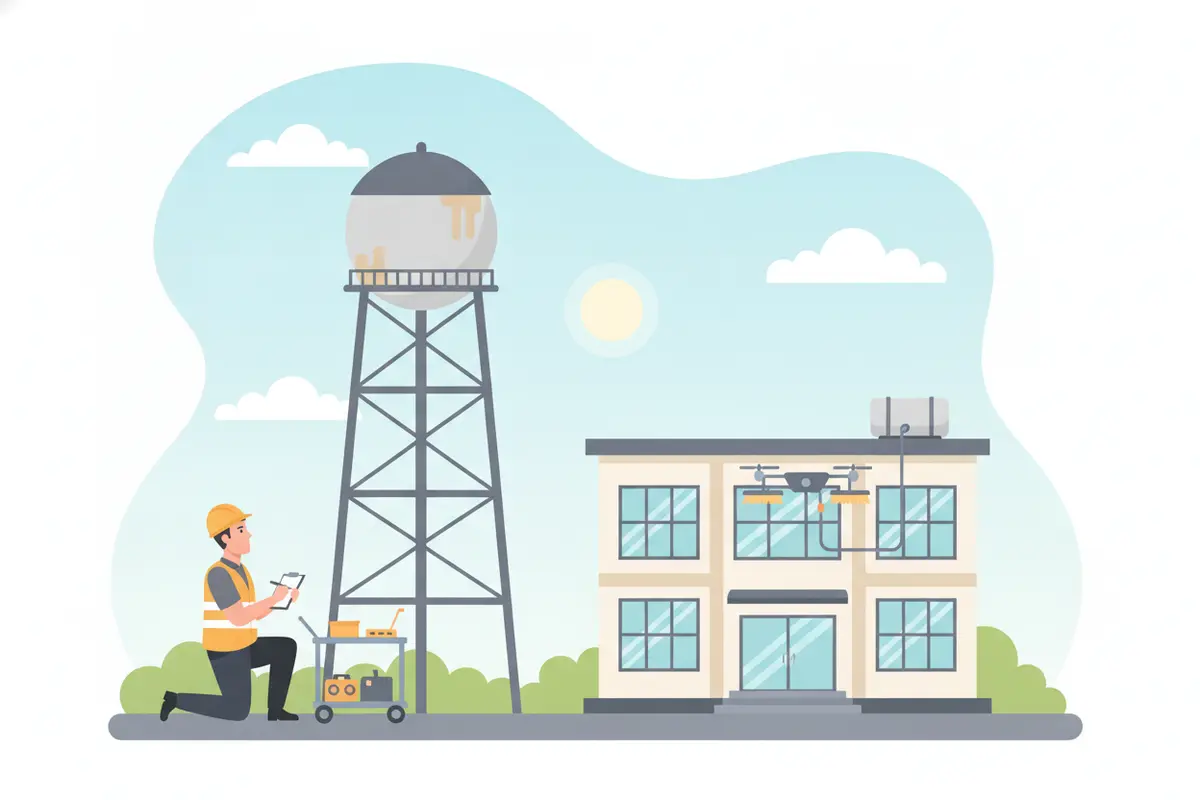
Keep the work scopes separate in purchase orders and reports. If an inspection identifies a surface-cleaning need, share the relevant access and surface information with the cleaning provider. If cleaning is scheduled first, ask the inspector whether the timing could affect what they need to observe. The right sequence depends on the inspection purpose, not on a general rule that cleaning must always come first.
It can help to define the handoff in advance. For instance, the inspection professional may need photographs of the existing surface before it is washed, or may prefer cleaning to happen only after documented observations are complete. The cleaning provider, in turn, needs to understand which areas are included, what surface conditions are known, and whether nearby operations must continue. Settle these questions between the responsible parties rather than asking a cleaning crew to determine inspection requirements.
What should teams confirm before scheduling a water tower inspection?
A short pre-scheduling checklist helps prevent unclear scopes, missed access requirements, and avoidable rescheduling. Assign one person to coordinate the site and gather the information below. Start with the records already available, then ask the inspection professional what else is necessary rather than delaying a useful initial conversation while trying to assemble a perfect file.
- Identify the asset.
Record the tower’s location, type, approximate height, ownership, operational status, and any known access restrictions. Note whether it is part of a potable-water system or serves another purpose.
- State the reason for the inspection.
Describe the decision you need to make, such as documenting current condition, investigating a reported issue, planning maintenance, or confirming work completion. Avoid suggesting a diagnosis before an assessment.
- Define the requested observations.
Ask whether the scope covers exterior surfaces, coatings, structural components, internal areas, appurtenances, or operational concerns. Do not assume one visit covers every element.
- Confirm qualifications and deliverables.
Ask who will conduct each part of the review, what experience or credentials the work requires, and what the report will include. Specify photos, locations, condition descriptions, limitations, recommendations, and any urgency categories you need.
- Review access and safety planning.
Confirm site permissions, operating constraints, access routes, escort needs, and any site-specific safety procedures. The responsible inspection professional should identify the access method appropriate to the scope. Do not improvise entry or work at height.
- Coordinate operations.
Determine whether the work requires a shutdown, restricted area, water-system coordination, traffic control, or advance notice to tenants and staff. Establish who can authorize operational changes.
- Gather records.
Make relevant drawings, prior inspection reports, maintenance history, coating information, and known repair records available when possible. Flag missing or uncertain records rather than treating them as verified facts.
- Agree on follow-up.
Identify who receives the report, who reviews recommendations, and how urgent findings will be communicated. Set a process for questions and for documenting decisions after the inspection.
Before confirming a date, also ask how the visit will be staged. Clarify who opens gates or restricted areas, where the inspection team can park and unload, and whether an escort must remain with the team. If the property has active deliveries, residents, or vehicle movement near the work area, identify a contact who can coordinate temporary controls. These details are site-specific, so confirm them with the responsible professional and your own safety procedures.
When the project also includes exterior cleaning, use a separate scope and quote. Skybots provides project-based cleaning and evaluates suitability based on the property and work conditions. Its commercial cleaning services describe cleaning offerings, not inspection certification. For industrial assets such as tanks and cisterns, ask directly whether the specific surface and setting fit the proposed method.
Which work should be scheduled: inspection, cleaning, or both?
The comparison below is a planning aid, not a substitute for advice from the qualified professional responsible for your asset. Roles may vary by site and contract, so write down who owns each deliverable.
Work item | Main purpose | Questions to settle | Typical output |
Inspection or condition assessment | Evaluate specified conditions and support a maintenance or operational decision | Who is qualified? Which areas are included? What are the access limits? | Findings, documented limitations, and recommendations within the agreed scope |
Exterior cleaning | Remove suitable surface soils using an agreed cleaning method | Is the surface appropriate? What access, water, and site controls are needed? | Completed cleaning work and a description of the work performed |
Repair or coating work | Address a condition identified and authorized under a separate scope | What specification, preparation, materials, and approvals apply? | Repair or coating records defined by the project contract |
Coordinated inspection and cleaning | Plan related work while preserving the inspection purpose | Which comes first? What evidence must remain visible? Who coordinates? | Separate records and clear sequencing responsibilities |
A table like this can also help compare proposals. Review whether each contractor has described the same asset, included areas, exclusions, access plan, timing, and deliverables. A lower or higher price cannot be meaningfully compared if the scopes differ. For Skybots, pricing follows an on-site inspection and a custom quote rather than a universal rate.
When reviewing proposals, check that assumptions are visible. One proposal may include only an exterior visual review while another includes close access or a more detailed report. Similarly, cleaning proposals may differ in the areas treated, preparation, water access, and what happens if weather or site activity interrupts the work. Ask each provider to list exclusions and conditions that would change the scope. Then compare like with like, instead of treating a single line-item price as a complete measure of value.
A simple coordination example: a facility team wants both a condition record and the removal of visible surface deposits. The team can first ask the inspection professional what must be observed before cleaning. If an initial record is needed, schedule that review first, share any relevant findings with the cleaning provider, and then set cleaning dates and boundaries. If the inspector says cleaning will not affect the requested observations, the order may differ. Keep the decision documented so later reviewers understand why the sequence was chosen.
How should teams document findings and next steps?
Good records make it easier for the next person to understand what was observed, what was not assessed, and what decision followed. Ask for a report that identifies the asset and inspection date, describes the agreed scope, and distinguishes direct observations from recommendations. It should also state access constraints or other limitations that affected the review.
After receiving the report, assign an owner to review each recommendation. Record whether the team will act, seek another opinion, monitor a condition, or defer work, along with the reason and any next review date. If the report identifies a time-sensitive concern, follow the responsible professional’s direction and the site’s procedures rather than relying on a cleaning schedule to resolve it.
Make the report usable for people who were not present. Where the scope calls for photographs, label them with a location or component, and connect each image to the relevant observation. Keep the original report and any follow-up notes together. If the team commissions repair or coating work later, preserve the authorization and completion records alongside the inspection findings without rewriting the original observations.
Keep cleaning records distinct. A useful cleaning record identifies the surfaces treated, date, method, and any agreed exceptions or areas not reached. It should not be filed as an inspection report. For more on organizing exterior work, see Skybots’ guide to choosing building cleaning services and its article on reducing maintenance risk.

When are window cleaning drones a fit for nearby exterior work?
A water tower inspection does not automatically create a need for drone cleaning. Consider a cleaning assessment only when there is a specific exterior surface-cleaning need and the structure is suitable for the method. The provider will need to understand height, surface type, site access, nearby activity, clear flight paths, and access to water. Skybots uses battery-powered equipment; do not assume a job uses a continuous power connection.
For buildings in its service area, Skybots offers drone cleaning in Miami and serves South Florida locations including Miami-Dade County and Broward County. These pages describe cleaning service availability, not water tower inspection coverage. A site review is needed to determine whether a particular exterior cleaning project is appropriate.
For any cleaning method, the property team should share surface details, access constraints, water availability, and operational requirements early. Skybots’ operators follow FAA-compliant flight operations according to company information, and the service process depends on trained people, planning, and communication as well as equipment. For a cleaning project, ask how the work area will be coordinated and how questions or requested touch-ups are handled during the company’s three-day feedback window, when applicable.
To make an initial suitability discussion more useful, provide clear photos from several angles and note the approximate height, surface material, nearby obstacles, water access, and hours when the area is active. Describe the cleaning result you need without assuming that every deposit or finish can be treated the same way. A provider can then identify what still needs to be checked on site and whether another method or a different scope should be considered. A cleaning suitability review remains separate from the tower’s technical inspection.
Frequently Asked Questions
Does a cleaning drone inspect a water tower?
No. A cleaning drone is used for an agreed cleaning task. It should not be treated as a substitute for an inspection by a qualified professional, structural evaluation, or water-quality assessment.
Should the tower be cleaned before an inspection?
There is no universal sequence. Ask the inspector whether existing deposits or surface conditions need to be documented before cleaning. Coordinate timing so cleaning does not obscure evidence needed for the inspection.
What information should a water tower inspection report include?
Agree on the report before the visit. Depending on the scope, it may document the asset, date, reviewed areas, observations, limitations, photographs, and recommendations. The responsible professional should define what is appropriate for the work requested.
How is a drone cleaning project priced?
There is no universal price in the information provided. Skybots determines pricing through an on-site inspection and a custom quote. Structure, surface, height, access, and project conditions can affect whether a cleaning method is suitable and how the work is scoped.
Plan the next step with a clear scope
Start with the inspection decision your team needs to make, then confirm the responsible professional, access plan, reporting needs, and operational coordination before setting a date. If exterior cleaning is also needed, scope and document it as separate work so each service has a clear purpose and accountable outcome.


Comments